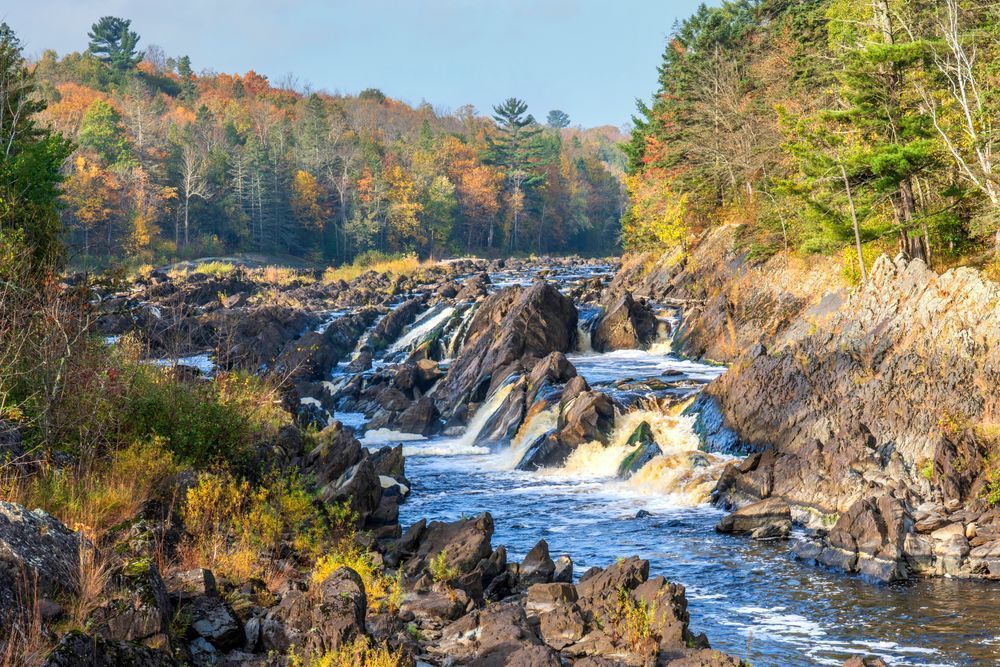
The St. Louis River does not ask permission. Through the gorge at Jay Cooke State Park, it moves the way it has always moved, threading through angled slabs of slate and greywacke, splitting around outcrops, dropping in short cascades that churn the water white before it settles back into dark current. Standing on the Swinging Bridge in October, you feel all of it: the vibration underfoot, the sound rising up from the gorge below, the smell of moving water and wet stone.
That is where I was when I made this photograph.
Looking upstream from the bridge, the river fills the lower two-thirds of the frame, rocky, turbulent, textured with rapids. The geological story is written in the rock itself. This is some of the oldest exposed bedrock in Minnesota, tilted at steep angles by forces acting on it long before anything walked on land. The dark stone has been polished and carved by the river over thousands of years, and in October, the contrast between that ancient geology and the fresh color of the hillside above it is nothing short of spectacular.
The fall color at Jay Cooke tends to peak earlier than the rest of Minnesota; the elevation and the proximity to Lake Superior's weather patterns push the season forward. On the morning I captured this, the maples and aspens on the ridge had already turned fully, with pockets of deep red visible through the canopy. The white pines held their green. The result is a palette that feels almost curated: rust, copper, amber, and gold against the iron-dark rock and the blue-white of moving water.
This image works in any space that wants energy and presence rather than stillness. It is a natural fit for cabins, lake homes, and northwoods-themed interiors, but it also holds its own in corporate and hospitality settings where the goal is a bold, grounding landscape. Large format is where it earns its full impact; the detail in the water and the rock face rewards the bigger print.