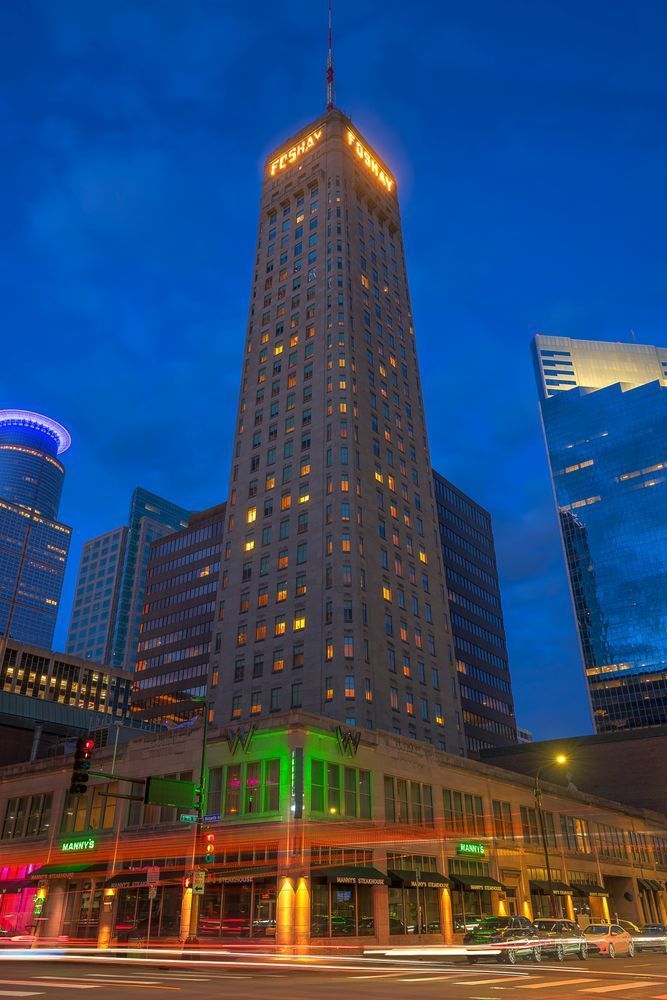
I had photographed the Foshay Tower many times; it appears in skyline shots, in wide cityscapes, as a background element in dozens of frames. But I had never gone downtown with the specific intention of making it the subject. That changed on a May evening in 2025, when I set up at the corner of South Marquette Avenue and 9th Street and waited for the light to do what blue hour does to a city like Minneapolis.
What blue hour does, specifically, is this: it compresses the difference between the lit interior of a building and the sky behind it, so that everything glows at roughly the same intensity. The Foshay's warm amber windows. The deep cobalt of the sky. The green wash of the W Hotel marquee at street level. The red and white light trails from the cars moving through the intersection. In full dark, those elements would compete. At blue hour, they harmonize.
The Foshay Tower opened in 1929, the same year the stock market crashed and the man who built it, utilities magnate Wilbur Foshay, was arrested for mail fraud. For decades, it stood as both a monument and a cautionary tale, the tallest building in Minneapolis until 1972. Today, it is a W Hotel, its upper observation deck open to guests, its name still blazing in lights from all four sides of the crown. It is one of the few Art Deco skyscrapers left in the Upper Midwest, and at street level it still commands the block the way it always has, anchoring the corner while everything modern rises around it.
That tension, between the Foshay's 1929 limestone and the glass towers pressing in from every side, is what this photograph is really about. History and contemporary Minneapolis sharing the same frame, the same sky, the same evening.
This print belongs in spaces that want downtown Minneapolis with depth and character rather than just spectacle. Law offices, financial firms, hospitality properties, and corporate interiors with a connection to the city's history are natural fits. The vertical format and the strong central composition make it a compelling statement piece on its own, and it pairs naturally with other Minneapolis nightscapes for a multi-panel installation.